
Diseño del proceso de tratamiento de gases residuales
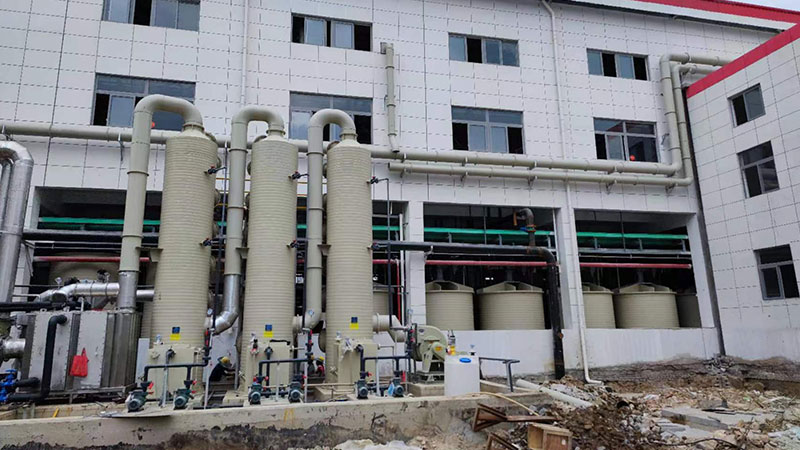
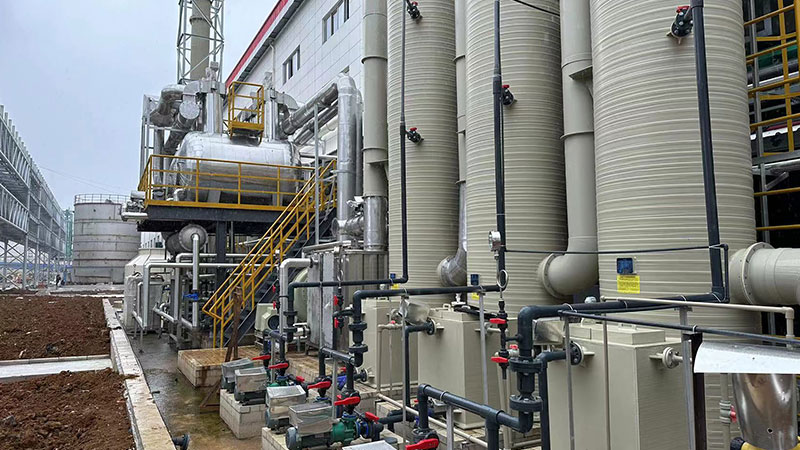
En pretratamiento de gases de escape orgánicos consta de lavado alcalino en dos etapas, lavado con agua en una sola etapay eliminación de la niebla de refrigeración superficial.
- En torre de lavado alcalino elimina la neblina de ácido sulfúrico y el cloruro de hidrógeno de los gases de escape.
- Una vez eliminados los componentes ácidos, un torre de lavado con agua tampones para reducir el impacto de la lejía arrastrada en los equipos de adsorción posteriores.
Los gases de escape pretratados (sin ácido, deshidratados y con humedad regulada) se presurizan mediante un ventilador y se envían a un depósito de adsorción de carbón activo en condiciones adecuadas. Una vez que el carbón activado se satura tras un periodo de adsorción, su rendimiento disminuye.
Desorción periódica Es necesario eliminar los gases residuales orgánicos de la superficie del carbón activado para restaurar su capacidad de adsorción. Este proceso se basa en el hecho de que el carbón activado tiene alta capacidad de adsorción a temperatura ambiente y baja capacidad a altas temperaturas para reciclarlo, lo que se conoce como adsorción por variación de temperatura en el sector.
Los gases de escape purificados se expulsan por el punto más alto de la chimenea, que cuenta con puertos de detección y supervisión en línea, junto con una plataforma de supervisión y barandillas, que cumplen con la normativa local y nacional pertinente.
TYIC se dedica a la fabricación de torres de absorción de nieblas ácidas, las tuberías correspondientes y los equipos relacionados, así como al tratamiento de la absorción de nieblas ácidas en gases no canalizados y a la gestión de gases residuales que contienen ácido. (La capacidad de eliminación de nieblas ácidas de la torre de absorción de nieblas ácidas de TYIC es de 1001 TP3T.)
CUALQUIER COSA QUE NO PUDIERAS ENCONTRAR?
Ventajas de nuestra empresa
TYIC se centra en el mercado mundial. Contamos con las siguientes ventajas:
- Ciclo de pago personalizado
- Bajo coste
- Equipo técnico profesional
- Estricto control de calidad.
- Respuesta rápida o entusiasmo.
ENVÍENOS UN CORREO ELECTRÓNICO
Solicitar presupuesto
De acuerdo con los requisitos del cliente y las características del producto, completar la planificación y el diseño de todo el conjunto de la línea de producción de lixiviación y extracción.
 Español
  English
  Deutsch
  Français
  Português
  Italiano