
What is a Mixer‑Settler?
A mixer‑settler is a piece of liquid‑liquid extraction equipment that combines two contiguous zones: a mixing chamber where two immiscible liquid phases (for example an aqueous feed and an organic extractant) are vigorously contacted to allow solute transfer, and a clarification (or settling) chamber where, under the influence of gravity, the mixed emulsion separates into its constituent phases.
This device is widely used in hydrometallurgical solvent extraction operations for the separation and purification of metals; it enables continuous or multi‑stage operation for deep separation, by directly coupling the mixing and settling steps.
Keep reading to explore how mixer‑settlers work, when to use them and how to choose/design one for your industrial process.
Indice dei contenuti
BASIC MIXER‑SETTLER OPERATION PRINCIPLES
In a typical Mixer‑Settler installation the two main sub‑units (mixer and settler) are designed to accomplish sequentially: (1) intimate contact and mass‑transfer between two immiscible phases, and (2) gravity‑driven phase separation of the emulsion produced in the mixer.
Mixing (Mass‑Transfer) Stage
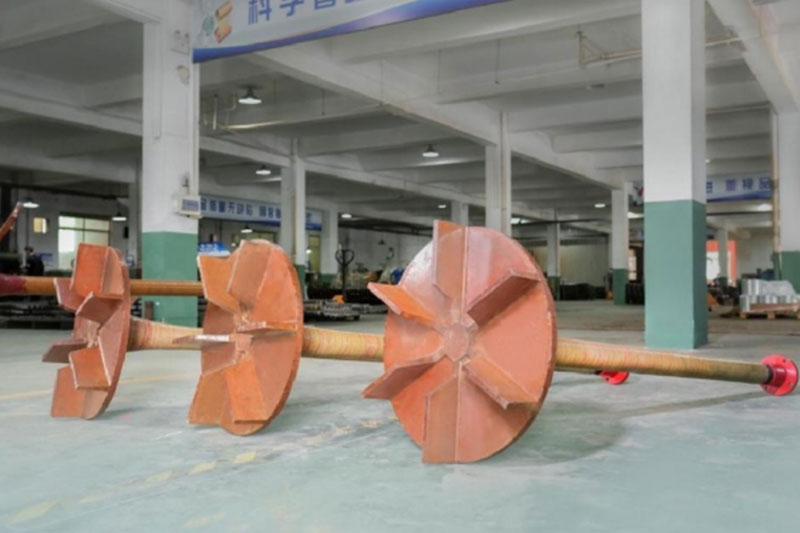
The feed (for example aqueous solution containing metal ions) and the solvent/extractant (often organic) are introduced into the mixing chamber in a defined ratio. An agitator (such as a turbine or impeller) provides strong shear, dispersing one phase into the other, thus creating fine droplets and a large inter‑facial area. The increased contact area, combined with sufficient residence time, allows the target solute to transfer from one phase into the other.
Key variables affecting the mixing efficiency include:
-
agitation speed (shear and droplet formation)
-
residence time in the mixing zone (time for mass transfer)
-
phase ratio (organic/aqueous)
-
droplet size/distribution (affects transfer and subsequent separation)
-
phase continuity (which phase is continuous vs dispersed)
Settling (Separation) Stage
Once mixing is complete, the emulsion overflows or is pumped from the mixing chamber into a quiet settling chamber. The difference in density between the phases causes them to separate under gravity: the heavier phase settles to the bottom, the lighter phase rises to the top. Coalescence aids (such as plates, baffles) may be provided to enhance droplet merging, reduce entrainment, and shorten separation time.
The two separated phases are then removed (light phase via a weir or overflow; heavy phase via bottom outlet or weir) and can be either sent to downstream processing or into the next stage of extraction. The interface height between the phases can often be adjusted via weirs or adjustable barriers to control phase take‑off points.
Multi‑Stage or “Battery” Operation
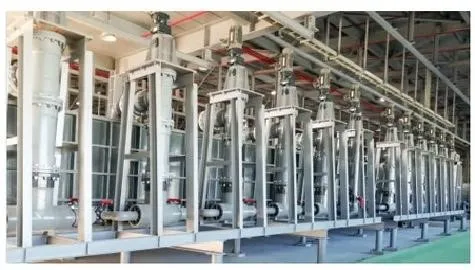
In many industrial applications the mixer‑settler units are arranged in series (sometimes eight or more stages) in a counter‑current configuration: the feed enters at one end, the solvent/extractant at the opposite end, and the phases flow in opposite directions through each stage. This configuration enhances separation efficiency and brings the system closer to equilibrium.
However, as stage count increases, so do capital costs (settler area, mixer size, solvent inventory) and the equipment footprint—so typically only a limited number of stages (3‑4) are used with mixer‑settlers.
Thus, the mixer‑settler offers a robust, flexible contacting/separation solution for liquid‑liquid extraction where a moderate number of stages and large volumetric flow are required, especially in hydrometallurgical and chemical purification plants.
Laboratory mixer‑settler, liquid–liquid extraction
In pilot‑plant or laboratory scale work, a smaller version of the mixer‑settler is often used to validate process conditions, study mass‑transfer kinetics, phase behaviour and settling characteristics before full–scale design. These lab units typically replicate the two‑zone structure of industrial mixer‑settlers but with reduced volumes (litres rather than cubic metres) and transparent materials for observation.
Such laboratory mixer‑settlers enable experiments on parameters such as: droplet size distribution under given stirring speed, phase entrainment in settling, phase continuity inversion (which phase becomes continuous under given flow ratios), as well as the approach to equilibrium (percentage extraction relative to theoretical) under controlled conditions.
In many cases the lab mixer‑settler is used in series (a battery) of a few stages (2‑4) to mimic counter‑current behaviour on a small scale, enabling engineers to optimise solvent/feed ratios, mixing intensity, residence time, settler area, and to scale‑up with more confidence.
Given the role of a lab mixer‑settler in process development, it is advisable to select one with the ability to adjust mixing speed, to vary flow rates, to monitor interface heights, and made of chemically compatible construction materials (especially when aggressive solvents or high acidity are involved). The lessons learned in lab scale (droplet size vs mixing speed, settling time vs phase ratio) form the basis for the design of full‑scale mixer‑settler equipment.
Brief Introduction of Mixer‑Settler
In hydrometallurgical solvent extraction, the mixer‑settler is a preferred contacting device because it integrates mixing and clarifying within one unit train while offering operational flexibility. It consists of a mixing chamber that continuously receives the feed and solvent, stirs them to form an emulsion, followed by a clarification chamber that uses gravity for phase separation. In practice, multiple stages of mixer‑settlers are connected in series to deepen the separation of the target components. Under given process conditions, the mass‑transfer efficiency of the mixing chamber is influenced by factors such as the stirring paddle intensity and the contact time of the two phases; meanwhile, the clarification performance is governed by phase physical properties including viscosity, density, surface tension, droplet diameter, and the clarification area.
Work process of Mixer‑Settler
To understand the work process of a mixer‑settler, consider the following two main subprocesses: (1) mixed mass transfer, and (2) two‑phase separation.
Mixed Mass Transfer Process
In typical practice the extraction solvent (light phase) and the material feed liquid (heavy phase) are introduced at the bottom of the mixer chamber in a predetermined ratio. A stirrer or turbine (sometimes a pump‑mix turbine) draws the liquids and disperses them, achieving intimate mixing and droplet formation. This shearing and dispersion step ensures a large contact interface between phases and allows the solute of interest to transfer from one phase to the other. After sufficient residence time, the mixed emulsion (now containing solute‑enriched solvent and solute‑depleted feed) is pumped or flows by overflow into the settling chamber.
Two‑Phase Separation Process
Once in the settler, the mixing stops and the emulsion enters a quiescent environment where gravity acts. The phase with higher density (usually aqueous) settles downward, while the lighter phase (organic) rises. Coalescer plates or internals may improve droplet merging and reduce entrainment. The interface between the phases is controlled via weirs or adjustable barriers. The separated heavy and light phases then exit the unit: the heavy phase may go to further processing or the next stage, and the light phase may either go off to stripping or next extraction. If a multi‐stage battery is used, each phase may feed into adjacent stages in counter‐current mode.
Professional design of the mixer‑settler ensures that the mixer produces droplets small enough for efficient mass transfer but large enough to settle effectively, and that the settler area and residence time are sufficient for the required throughput without entrainment or flooding.
Wide Application Field
Mixer‑settlers find broad use in industries where liquid–liquid extraction is required. Key application fields include:
-
Hydrometallurgy and metal recovery: For example, the extraction and purification of copper, cobalt, nickel, uranium and rare‑earth elements from leach solutions and aqueous feeds.
-
Chemical manufacturing and organic separation: Separation of organics, acids, amines, phenols, and other compounds via extraction processes.
-
Battery recycling and new energy materials: In the recycling of lithium‑ion batteries, where metals such as lithium, nickel, cobalt, manganese, and copper must be extracted and purified, mixer‑settlers are often employed for solvent extraction steps.
-
Environmental protection/waste treatment: Treatment of industrial waste streams via extraction of heavy metals, solvents or pollutants into a solvent phase and subsequent separation.
-
Pharmaceuticals and food industry: In laboratory‑scale extraction of fine chemicals, active pharmaceutical ingredients, flavors or natural products, small‑scale mixer‑settlers provide easy process development.
Because of this versatility, the mixer‑settler remains a “workhorse” technology for continuous liquid-liquid extraction, particularly where moderate number of stages, large flows, and robust separation are required.
Procurement Decision Recommendations
When selecting or specifying a mixer‑settler system for an industrial application (such as those relevant to extraction of metals, chemical separation or environmental treatment), several key factors should be considered:
-
Number of stages required
-
Material of construction
-
Mixer design & agitation capability
-
Settler area / residence time / internals
-
Phase ratios and flow rates
-
Scalability and pilot data
-
Maintenance, accessibility and footprint
-
Integration with your process
By focusing on these areas, you can specify a mixer‑settler system that delivers high performance, operational reliability and long‑term value in demanding applications such as metal recovery, battery recycling, chemical purification and wastewater treatment.
Sintesi
The mixer‑settler is a mature yet highly effective piece of process equipment for liquid–liquid extraction: its two‑zone design (mixing + settling) supports efficient contact and separation, and when configured in multiple stages it can deliver deep separation performance. With careful attention to mixer design, settler sizing, materials of construction and process data from lab/pilot work, it remains a strong choice for industries ranging from hydrometallurgy and battery recycling to chemical and environmental processing.
 Italiano
  English
  Deutsch
  Français
  Português
  Español